Honeywell BW: Detection Technologies Tailored to the Field
At an industrial site, the possible presence of a hazardous gas is not always indicated by noticeable signs. A combustible gas leak, exposure to a toxic substance, or an abnormal change in oxygen levels may require a rapid alert. Honeywell BW detectors address this need with devices designed to monitor specific gases and alert users when configured alarm thresholds are reached.
Depending on the model and the gases being detected, the product line utilizes various measurement technologies, including electrochemical, catalytic, and infrared methods. It combines individual solutions and zone sensors, as well as distinct operating modes: devices with a predefined service life, reusable detectors, or rechargeable multi-gas equipment. It is these differences, as well as the number of gases measured, that guide the choice in the field.
Which Honeywell BW detector is best suited for which professional application ?
Our selection covers three complementary surveillance scenarios. The choice depends first on what you need to detect, then on the people or locations you need to protect, and finally on how the devices will be used and monitored.
Single-gas detection: BW Clip, BW Clip RT, and BW Solo Wireless
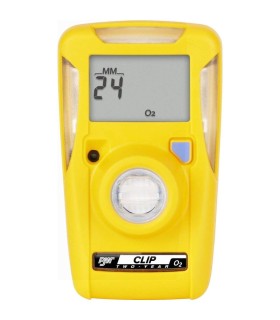
The Honeywell BW Clip and BW Clip RT These are suitable when a risk assessment identifies a gas that needs to be monitored on a regular basis. Their operation over a predefined service life simplifies the day-to-day management of the devices. The versions marketed by MMF cover CO, H₂S, O₂, and SO₂, with service lives of two or three years depending on the gas and configuration. The BW Clip RT also features a display showing the measured concentration, which is useful when direct reading of this value is part of operational requirements.
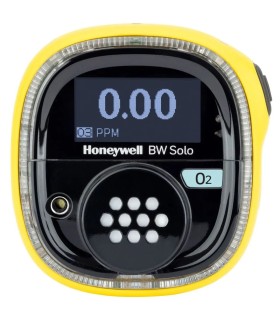
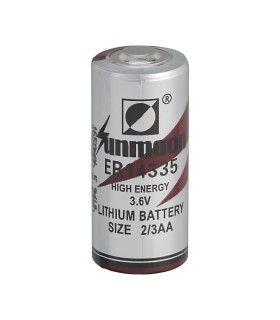
The Honeywell BW Solo Wireless operates on a different principle. This reusable device features a replaceable battery, filter, and sensor. It is particularly well-suited for operators who wish to integrate the detector into a long-term maintenance and monitoring program. Its Bluetooth Low Energy connectivity simplifies certain configuration and data management tasks when used with compatible tools. Our selection includes models designed to monitor various gases, including CO, CO₂, H₂S, O₂, SO₂, Cl₂, and NH₃.
Personal Multi-Gas Detection: MicroClip X3 and BW Flex
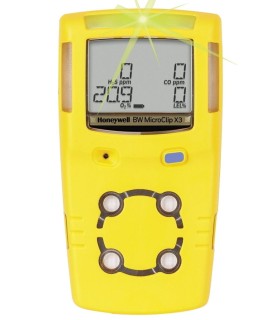
When multiple atmospheric hazards need to be monitored during a single operation, a personal multigas detector allows multiple measurements to be combined into a single device. The GasAlert MicroClip X3 is a compact, rechargeable solution for monitoring combustible gases (in % LEL), oxygen, carbon monoxide, and hydrogen sulfide. Its single-button operation meets the needs of teams that use a personal multigas detector on a daily basis.
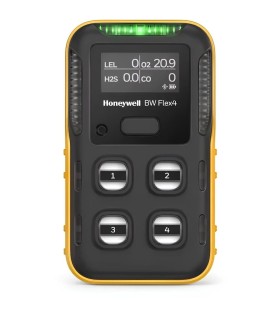
The Honeywell BW Flex stands out for its i-Series smart sensors, which provide information on their status, calibration, and maintenance. The product line offers various detection options depending on the sensors and configurations. It is of interest to operators who need to account for specific risks while managing the monitoring of their equipment. However, the exact combination of measured gases and available sensor technologies must be confirmed for the selected configuration.
Area Monitoring: The BW RigRat Beacon
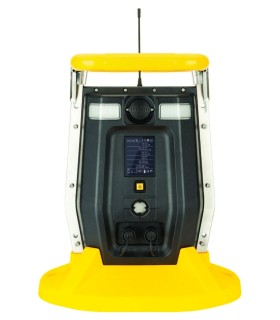
Personal protective equipment is not sufficient in all situations. During a plant shutdown, maintenance work, or temporary operations, it may be necessary to monitor the atmosphere at a specific location and alert people in the vicinity. The Honeywell BW RigRat is designed for this purpose: it is a portable multigase detector with local alarms.
The area monitoring version offered by MMF monitors combustible gases in % LEL, O₂, CO, and H₂S. Installed at a location selected based on the risks, it can supplement the personal detectors worn by workers. It does not automatically replace them: the appropriateness of area monitoring depends, in particular, on the layout of the worksite, potential emission sources, and applicable safety guidelines.
Adapting Detection to the Constraints of Industrial Sites
The risks encountered at a production facility, in a refinery, in a sewer system, or during a maintenance shutdown are not the same. Some workstations require monitoring for a specific gas; while others potentially expose crews to multiple substances or to an atmosphere where oxygen concentrations may vary. It is also necessary to take into account the duration of the operation, environmental conditions, operator mobility, and the location of monitoring points.
Choosing a professional gas detector It therefore relies on the identification of the substances present, the measurement ranges, and the necessary alert thresholds, as well as on the actual conditions of use. However, a multigas detector is not capable of detecting all hazardous substances: it can measure only those gases for which it is equipped with the appropriate sensors.
For interventions in ATEX zone, you must also verify that the marking on the selected version is compatible with the location’s classification and the conditions of use. The mere mention of ATEX certification is not sufficient to establish this compatibility. To learn more about these concepts, please refer to our Guide to ATEX Zones and Markings.
Functional testing, calibration, and monitoring of detectors
Choosing the right device is the first step; ensuring that it will function reliably over the long term is another. The functional test, performed using a suitable test gas, is used to verify the sensors' response and the activation of alarms. TheCalibration This, in turn, allows you to monitor the measurement response and make the adjustments specified by the manufacturer when necessary. These procedures are complementary and should not be confused.
Test conditions, inspection intervals, consumables, and maintenance procedures vary depending on the detector and its intended use. For certain compatible models, Honeywell offers management equipment and tools—such as IntelliDoX and SafetySuite—designed specifically to facilitate the monitoring of devices and the operations performed. Their compatibility and functions must be verified based on the specific equipment in question. The manufacturer’s documentation and on-site safety procedures remain the primary references for organizing these inspections.
Effective detection begins with a thorough risk assessment
A personal single-gas detector, a personal multi-gas detector, and a zone monitoring beacon do not serve the same purpose. The Honeywell BW line allows you to combine these approaches based on the types of gases to be monitored, the duration of operations, and how teams carry out their work. It is this complementarity that makes a thoughtful selection worthwhile, rather than searching for a single device that works in all situations.
At MMF Protection et Sécurité, we offer a carefully curated selection of Honeywell BW equipment, with the option to evaluate Other configurations available upon request. You can find the models we sell in our category professional gas detectors or Contact Us to specify the gases involved, the site constraints, and the intended conditions of use.
The right detector isn't simply the one that measures the most gases—it's the one whose configuration, use, and monitoring are tailored to the actual risks in your work environment.



 English
 Français
 Deutsch
 Español