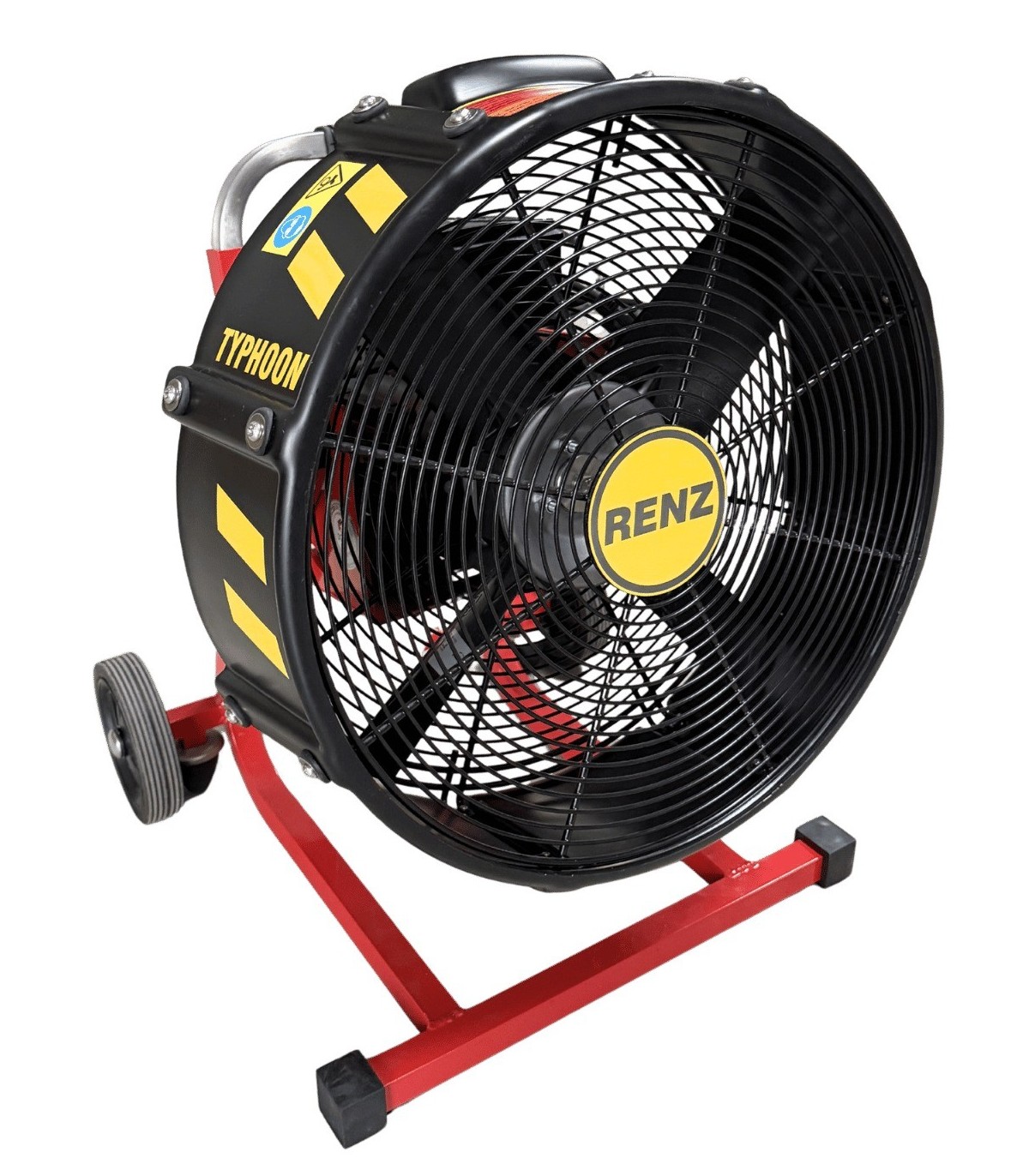
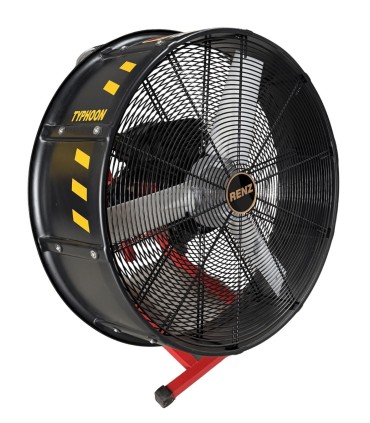
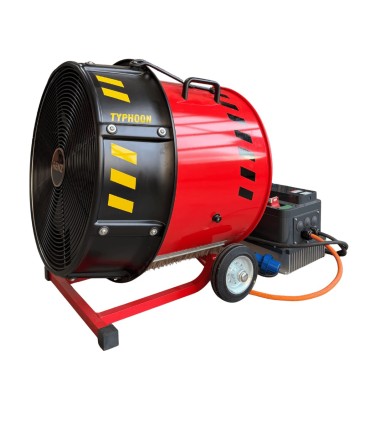
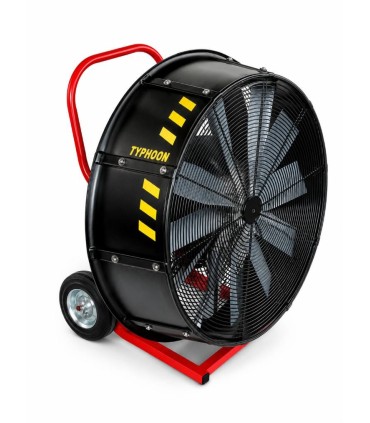
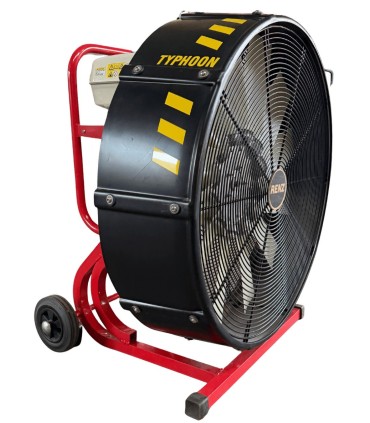
The TYPHOON 18E3.0-FU positive-pressure fan is a high-performance solution designed for smoke extraction and ventilation applications requiring precise airflow control. Equipped with a 2.2 kW 230 V electric motor paired with a built-in variable frequency drive, it allows the ventilation power to be gradually adjusted to meet the specific requirements of each application.
This adjustability makes it particularly well-suited for indoor spaces, openings of varying sizes, and industrial facilities where a constant maximum airflow is not always desirable. Compact, portable, and modular, it meets the needs of fire departments, industrial operators, and specialized maintenance teams.
A premium solution for precise airflow control
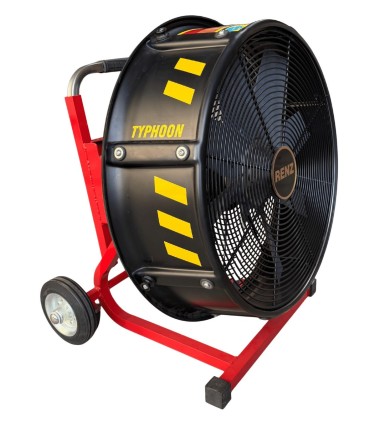
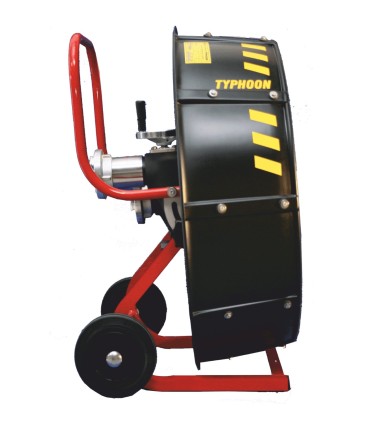
Mounted on wheels, the TYPHOON 18E3.0-FU moves easily around the site and can be positioned in front of a door, bay, or ventilation opening. Its variable-frequency drive allows the motor speed and airflow to be adjusted to the building’s layout, the volume to be treated, or the constraints of an industrial process.
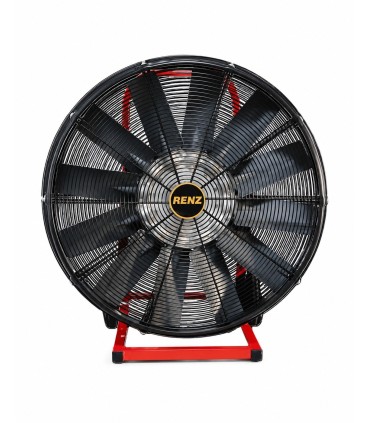
Its 18" / 457 mm, compliant with DIN 14963-EM standard —size class 1—delivers an adjustable airflow rate of 0 to 16,500 m³/h, which can exceed 26,000 m³/h depending on operating conditions. Weighing 25 kg, it combines compactness, portability, and adjustability.
A variable-speed electric motor
Unlike a fixed-speed electric fan, the TYPHOON 18E3.0-FU allows the motor speed to be varied thanks to its built-in frequency converter. This enables the user to gradually increase or decrease the airflow without interrupting operation.
Its 2.2 kW, 230 V electric motor operates without fuel and produces no direct exhaust emissions. The power cord connection with a 230 V IP68 plug facilitates its use in professional environments with a suitable power supply.
Adjustment Suited to Sensitive Configurations
In particular, the ability to vary the airflow helps prevent excessive pressure buildup, limit turbulence, or adapt the flow to a small opening. This feature is also useful for industrial operations requiring gradual and controlled air exchange.
Speed control thus offers greater flexibility than a fan operating solely at its rated speed. It allows the same equipment to be used for various configurations, ranging from moderate ventilation to the maximum available airflow.
Technical Specifications
| Technical Specifications – TYPHOON 18E3.0-FU Positive Pressure Fan |
| Product Type |
Variable-speed electric positive-pressure fan |
| Model |
TYPHOON 18E3.0-FU |
| Motor |
230 V electric motor with integrated frequency converter |
| Motor Power |
2.2 kW |
| Speed control |
Variable speed via frequency converter |
| Airflow |
Adjustable from 0 to 16,500 m³/h, up to over 26,000 m³/h depending on operating conditions |
| Weight |
25 kg |
| Nominal diameter |
18" / 457 mm |
| Connection |
Power cable with 230 V IP68 plug |
| Specified standard |
DIN 14963-EM – Size Class 1 |
| Mobility |
Wheel-mounted |
| Typical applications |
Adjustable-flow smoke exhaust, ventilation of sensitive environments, and industrial processes |
Applications
- Ventilation of sensitive environments requiring an adjustable airflow rate.
- Smoke exhaust in buildings where a constant maximum airflow is not desirable.
- Ventilation of openings of varying sizes.
- Gradual air renewal in technical rooms and workshops.
- Industrial ventilation requiring precise adaptation to process constraints.
- Extended indoor operations without direct exhaust gas emissions.
FAQ – TYPHOON 18E3.0-FU Positive Pressure Fan
What is the advantage of the variable-frequency drive compared to the TYPHOON 18E3.0?
The variable frequency drive allows for gradual adjustment of motor speed and airflow. The TYPHOON 18E2.2 operates at a fixed speed, whereas the TYPHOON 18E3.0-FU can be more precisely adapted to the size of the opening and the volume to be ventilated.
What type of power supply is required?
The fan requires a 230 V AC power supply compatible with its 2.2 kW motor power. The variable frequency drive is built into the unit and does not require external control equipment.
Why reduce the airflow during a ventilation operation?
A reduced airflow rate can be useful to prevent excessive pressure buildup, limit turbulence, accommodate a small opening, or ensure a gradual air exchange in a mechanical room or a sensitive industrial environment.
Can the airflow actually be adjusted from zero?
The variable-speed drive allows for gradual control of the fan speed up to the maximum available airflow. The specific startup conditions, minimum operating range, and settings must comply with the manufacturer’s technical instructions.




 English
 Français
 Deutsch
 Español